IP Camera vs Analog CCTV Camera: What's the Difference?
Introduction
CCTV cameras have become an essential part of modern security systems. They help homeowners and businesses monitor activities, prevent unauthorized access, protect valuable assets, and review recorded incidents. Among the different surveillance technologies available today, IP cameras and analog CCTV cameras remain two popular choices.
Although both systems perform the basic function of video surveillance, they work differently. IP cameras use digital network technology, while traditional analog CCTV cameras transmit video through coaxial cables to a DVR. Understanding these differences can help you select the right system according to your security requirements, budget, and property infrastructure.
What Is an IP Camera?
An IP camera, also known as an Internet Protocol camera, is a digital surveillance camera that transmits video and data over a computer network. It can be connected using Ethernet cables or, in some cases, Wi-Fi. IP cameras are widely used in modern security systems because they can provide high-resolution video, remote access, intelligent analytics, and network-based management.
These cameras can connect to Network Video Recorders (NVRs), cloud platforms, and other network devices, making them suitable for both small and large surveillance installations.
What Is an Analog CCTV Camera?
An analog CCTV camera captures video and sends the signal through coaxial cables to a Digital Video Recorder (DVR). The DVR processes the video and stores the recorded footage for later viewing.
Analog CCTV systems have been used for many years and remain popular because they can be relatively affordable and straightforward to install. They can be particularly useful for properties that already have coaxial cabling infrastructure.
Difference in Video Quality
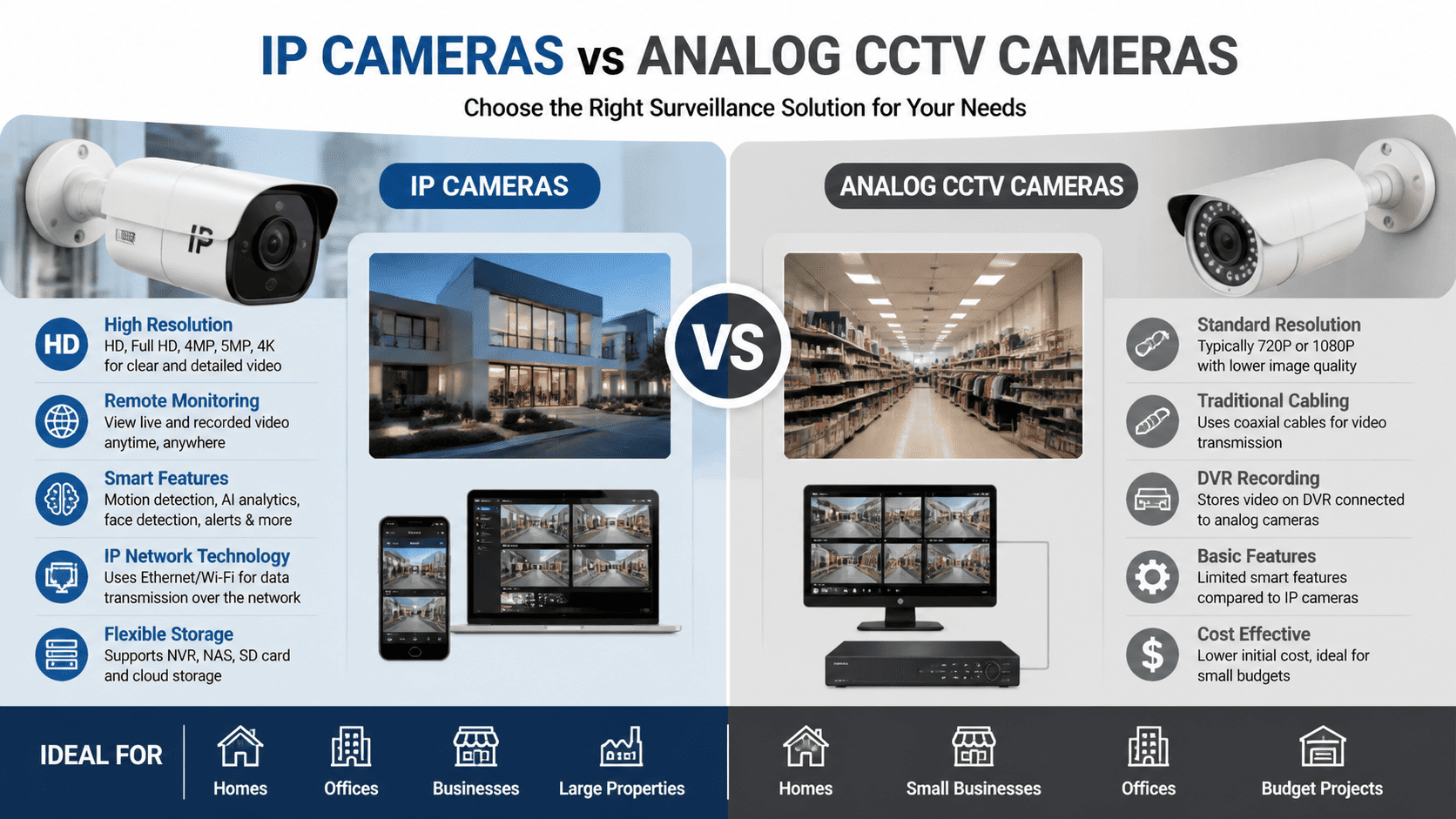
Video quality is one of the major differences between IP and traditional analog CCTV systems. IP cameras generally provide higher-resolution digital footage, allowing users to capture greater detail when monitoring people, vehicles, entrances, and other areas.
Modern HD-over-coax technologies have improved the quality of analog CCTV systems considerably, but the capabilities available depend on the specific camera and recorder technology being used.
Difference in Connectivity
IP cameras communicate through network infrastructure. They can use Ethernet connections, and compatible systems can use Power over Ethernet (PoE) to transmit both power and data through a single network cable.
Traditional analog cameras normally use coaxial cables to transmit video to a DVR, with power commonly supplied separately. Therefore, IP systems are more closely integrated with modern network infrastructure.
Storage and Recording
IP camera systems generally use NVRs, network storage, or cloud-based storage. Since the video is transmitted digitally, IP systems can integrate with various network storage solutions.
Analog CCTV cameras generally send their video signals to a DVR, which processes and stores the recordings. The storage capacity depends on the DVR's hard drive and configuration.
Remote Monitoring
Both IP and modern analog CCTV systems can support remote monitoring when connected to appropriate network-enabled recording equipment.
However, IP cameras are designed around network connectivity, making them particularly convenient for applications that require centralized management, remote access, and integration with other network-based security technologies.
Installation Requirements
IP cameras generally use Ethernet cables and may use PoE technology, which can simplify installation by carrying power and data through the same cable.
Traditional analog CCTV systems commonly require coaxial cables and separate power connections. However, the actual installation requirements depend on the specific equipment and existing infrastructure.
Scalability
IP camera systems are generally well suited for expanding surveillance networks. Additional cameras can be added to an existing network when sufficient network bandwidth, PoE capacity, and NVR resources are available.
Analog systems can also be expanded, but the number of cameras may depend on the available channels on the DVR and the existing cabling infrastructure.
Smart Features
Modern IP cameras commonly support advanced features such as motion detection, person detection, vehicle detection, facial recognition, license plate recognition, two-way audio, and AI-based video analytics.
Some modern analog CCTV systems also provide intelligent features through compatible cameras and DVRs. However, IP cameras generally offer greater flexibility for advanced network-based applications.
Cost Considerations
Analog CCTV systems can be a cost-effective choice, especially for smaller installations or properties that already have suitable coaxial cables. They can provide reliable surveillance without requiring extensive network infrastructure.
IP cameras may require a higher initial investment because of network equipment, NVRs, PoE switches, and higher-resolution cameras. However, their advanced features, flexibility, and scalability can make them a valuable long-term investment for many businesses.
Which One Should You Choose?
The right choice depends on the requirements of your property. IP cameras are a strong option when you need high-resolution video, remote monitoring, advanced analytics, network integration, and future scalability. Analog CCTV can be suitable when you need straightforward surveillance, want to control initial costs, or already have coaxial infrastructure that can be reused.
Conclusion
IP cameras and analog CCTV cameras both provide effective surveillance, but their technologies and capabilities are different. IP cameras offer digital video, network connectivity, high resolution, scalability, and a wide range of smart features. Analog CCTV systems can provide reliable and affordable surveillance, particularly where existing coaxial infrastructure is available.
Before selecting a CCTV system, consider your property's size, security requirements, budget, existing infrastructure, storage needs, and future expansion plans. Choosing the appropriate technology can provide reliable security and better long-term value.