How to Choose the Right CCTV Camera for Your Home or Business
Introduction
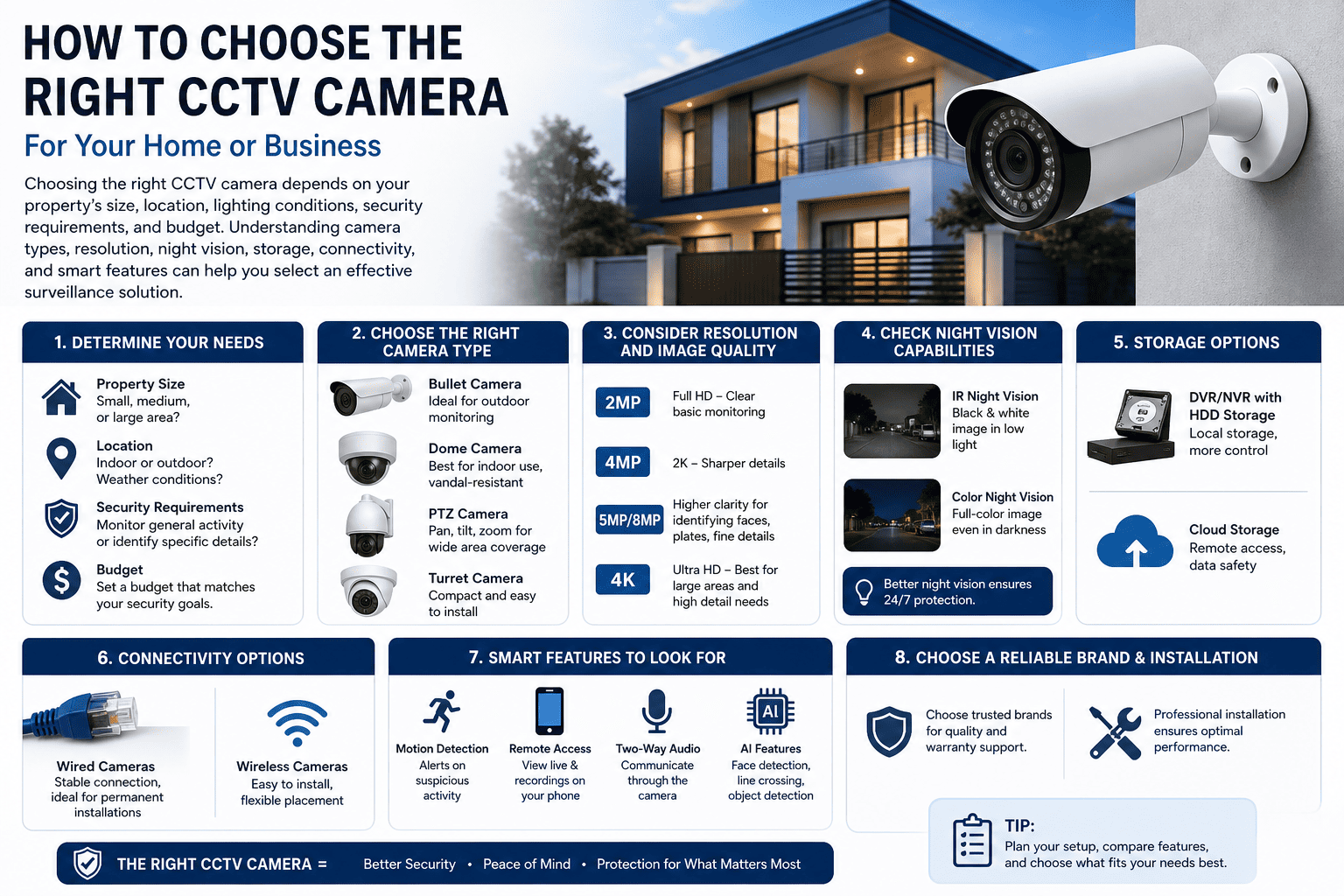
CCTV cameras have become an important part of modern security systems for homes and businesses. They help monitor properties, discourage unauthorized access, record important events, and provide remote visibility. However, with many types of CCTV cameras available, choosing the right one can be challenging. Dome cameras, bullet cameras, PTZ cameras, and IP cameras offer different features for different environments. Before purchasing a CCTV system, it is important to consider factors such as camera location, image quality, night vision, storage capacity, connectivity, and budget.
Understand Your Security Requirements
The first step is to identify what you want to monitor. A home may require cameras for entrances, driveways, parking areas, and common spaces, while a business may need surveillance for offices, warehouses, entrances, cash counters, and restricted areas. Identifying these locations helps determine the number and type of cameras required.
Choose the Right Camera Type
Different CCTV camera designs are suitable for different applications.
Dome cameras are commonly used indoors because of their compact and discreet design.
Bullet cameras are suitable for outdoor areas and can provide focused coverage over longer distances.
PTZ cameras allow users to remotely control the camera's pan, tilt, and zoom functions, making them useful for monitoring larger areas.
IP cameras transmit digital video over a network and can provide high-resolution footage and remote monitoring capabilities.
Consider Camera Resolution
Resolution determines how much detail a camera can capture. Higher-resolution cameras generally provide clearer footage, making it easier to identify people, vehicles, and other objects. For basic monitoring, standard HD cameras may be sufficient, while areas requiring greater detail may benefit from Full HD, 4MP, 5MP, or higher-resolution cameras.
Check Night Vision Capabilities
Security monitoring should continue after sunset. If the camera will operate in low-light or outdoor environments, choose a model with suitable night vision capabilities. Infrared technology allows many CCTV cameras to capture footage in darkness, while newer models may provide color images in low-light conditions.
Evaluate Storage Options
CCTV footage needs to be stored securely for later viewing. Common options include:
DVR or NVR storage
MicroSD card storage
Network-attached storage
Cloud storage
The required storage capacity depends on the number of cameras, video resolution, recording quality, and how long footage needs to be retained.
Wired vs Wireless CCTV Cameras
Wired CCTV systems generally provide stable connections and are suitable for permanent installations. Wireless cameras offer easier installation and greater flexibility, particularly where running cables is difficult. However, wireless systems depend on reliable network connectivity and should be installed in locations with adequate signal strength.
Look for Smart Features
Modern CCTV cameras offer advanced features such as motion detection, person detection, vehicle detection, two-way audio, mobile notifications, and AI-powered analytics. These features can reduce unnecessary alerts and make monitoring more convenient.
Consider Remote Monitoring If you want to monitor your property while away, choose a CCTV system that supports remote access through a smartphone or computer. Remote monitoring allows users to view live footage, review recordings, and receive security notifications from almost anywhere with an internet connection. Check Weather Resistance for Outdoor Cameras Outdoor cameras are exposed to rain, dust, heat, and other environmental conditions. Choose cameras designed for outdoor use with appropriate weather and dust protection. Proper mounting and installation are equally important for maintaining reliable performance. Compare Installation and Maintenance Costs The total cost of a CCTV system includes more than the camera price. Consider installation, cabling, storage, networking equipment, maintenance, and potential upgrades. Choosing quality equipment and professional installation can improve reliability and reduce future maintenance problems. Conclusion Choosing the right CCTV camera requires careful consideration of your property's security requirements, camera location, image quality, night vision, storage, connectivity, and smart features. A suitable CCTV system provides reliable surveillance while making it easier to monitor and protect your home or business. By comparing different camera types and selecting equipment based on your actual security needs, you can build an effective and long-lasting surveillance system.
Consider Remote Monitoring
If you want to monitor your property while away, choose a CCTV system that supports remote access through a smartphone or computer. Remote monitoring allows users to view live footage, review recordings, and receive security notifications from almost anywhere with an internet connection.
Check Weather Resistance for Outdoor Cameras
Outdoor cameras are exposed to rain, dust, heat, and other environmental conditions. Choose cameras designed for outdoor use with appropriate weather and dust protection. Proper mounting and installation are equally important for maintaining reliable performance.
Compare Installation and Maintenance Costs
The total cost of a CCTV system includes more than the camera price. Consider installation, cabling, storage, networking equipment, maintenance, and potential upgrades. Choosing quality equipment and professional installation can improve reliability and reduce future maintenance problems.
Conclusion
Choosing the right CCTV camera requires careful consideration of your property's security requirements, camera location, image quality, night vision, storage, connectivity, and smart features. A suitable CCTV system provides reliable surveillance while making it easier to monitor and protect your home or business. By comparing different camera types and selecting equipment based on your actual security needs, you can build an effective and long-lasting surveillance system.